Class 8th Science ; Ch- Reproduction in Animals
Class 8th Science
Ch- Reproduction in Animals
Ques 1. Explain the importance of reproduction in organisms.
Ans.
- Reproduction ensures the continuation of similar kinds of individuals, generation after generation.
- Reproduction is essential for the continuation of a species.
Ques 2.Describe the process of fertilization in human beings.
Ans.
- In human beings fertilization takes place inside the female body (internal fertilization).
- Males eject sperms inside female bodies
- Out of millions of sperms produced, one sperm will fuse with the egg cell.
- This process in which the ovum and sperm fuse to form zygote is called
- During this process the nucleus of the sperm fuses with the nucleus of the ovum to form a single diploid cell i.e., zygote.
Ques 3. Choose the most appropriate answer :
a. Internal fertilisation occurs : ( i )
i) in female body ii) outside female body
iii) in male body iv) outside male body
b. A tadpole develops into an adult frog by the process of : ( ii )
i) fertilisation ii) metamorphosis iii) embedding iv) budding
c. The number of nuclei present in a zygote is : ( ii )
i) none ii) one iii) two iv) four
Ques 4. Indicate whether the following sentences are True (T) or False (F) :
- a) Oviparous animals give birth to young ones. ( F )
- b) Each sperm is a single cell. ( T )
- c) External fertilization takes place in frog. ( T )
- d) A new human individual developed from a cell is called gamete. ( F )
- e) Egg laid after fertilization is made up of a single cell. ( T )
- f) Amoeba reproduces by budding. ( F )
- g) Fertilization is necessary even in asexual reproduction. ( F )
- h) Binary fission is a method of asexual reproduction. ( T )
- i) A zygote is formed as a result of fertilization. ( T )
- j) An embryo is made up of a single cell. ( F )
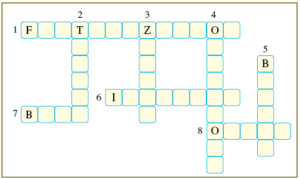
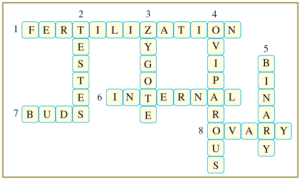
Ques 5. Complete the crossword puzzle using the hints given below.
Across :
1. The process of the fusion of the gametes.
6.The type of fertilisation in hen.
7.The term used for bulges observed on the sides of the body of Hydra.
8.Eggs are produced here.
Down :
2.Sperms are produced in these male reproductive organs.
3.Another term for the fertilised egg.
4.These animals lay eggs.
5.A type of fission in Amoeba.
A.
Ques 6. Give two differences between a zygote and a foetus.
Ans.
| ZYGOTE | FOETUS |
| i) The fertilised egg is called zygote. | i) The stage of embryo in which all the body parts are identifiable is called a foetus. |
| ii) Zygote is single celled. | ii) Foetus is multicellular. |
| iii) It is formed by the process of fertilisation. | iii) It is formed after the multiplication of zygote. |
| iv) It has no well-defined body parts. | iv) It has well defined body parts like limbs and other body part S |
Ques 7. Define asexual reproduction. Describe the two methods of asexual reproduction in animals.
Ans. The method of reproduction in which only a single parent is involved is called asexual reproduction. (Or) The reproduction that occurs without formation and fusion of gametes is called asexual reproduction.
The methods through which animals reproduce asexually are Budding, Binary fission etc.
a) Budding :
- In this method, a part of an organism starts bulging out. This is called
- This bud gradually grows and develops into a separate individual.
Eg : Hydra, Yeast etc.
b) Binary fission : In this method, the nucleus of an organism divides into two followed by division of their bodies, each part getting one nucleus and developing into a separate individual.
Eg: Amoeba, Bacteria etc.
Ques 8. In which female reproductive organ does the embryo get embedded ?
Ans. Uterus is the female reproductive organ in which embryo gets embedded.
9. What is metamorphosis ? Give examples.
Ans. The transformation of the larva into adult through drastic changes is called metamorphosis.
Eg : Silkworm, Frog etc.
ZYGOTE | FOETUS |
| i) The fertilised egg is called zygote. | i) The stage of embryo in which all the body parts are identifiable is called a foetus. |
| ii) Zygote is single celled. | ii) Foetus is multicellular. |
| iii) It is formed by the process of fertilisation. | iii) It is formed after the multiplication of zygote. |
| iv) It has no well-defined body parts. | iv) It has well defined body parts like limbs and other body part S |
Comments
Post a Comment